 Copyright © yoice.net – Quote Artwork
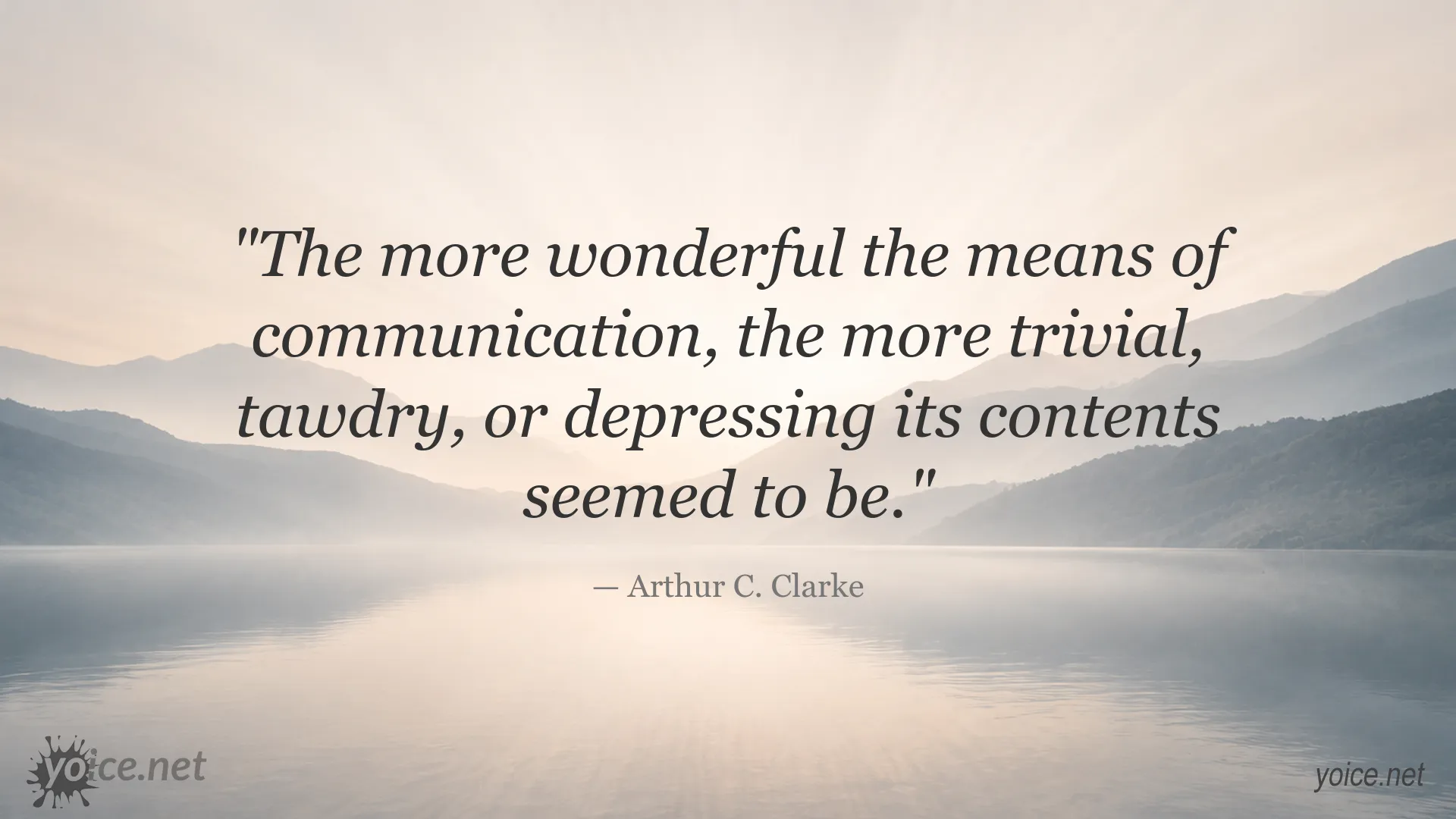
"The more wonderful the means of communication, the more trivial, tawdry, or depressing its contents seemed to be."
Arthur C. Clarke

Press Quotes – Reflections on the Role of the Press
A set of 428 quotes highlighting the press’s role in communication and its impact on society.
This collection of press quotes presents diverse viewpoints on the press’s role in society. The quotes reflect on communication, information dissemination, and opinion shaping. They encourage reflection on the press as a medium. Drawn from philosophy, culture, and media critique, the quotes offer insight into the press and its influence.
"The more wonderful the means of communication, the more trivial, tawdry, or depressing its contents seemed to be."
Arthur C. Clarke
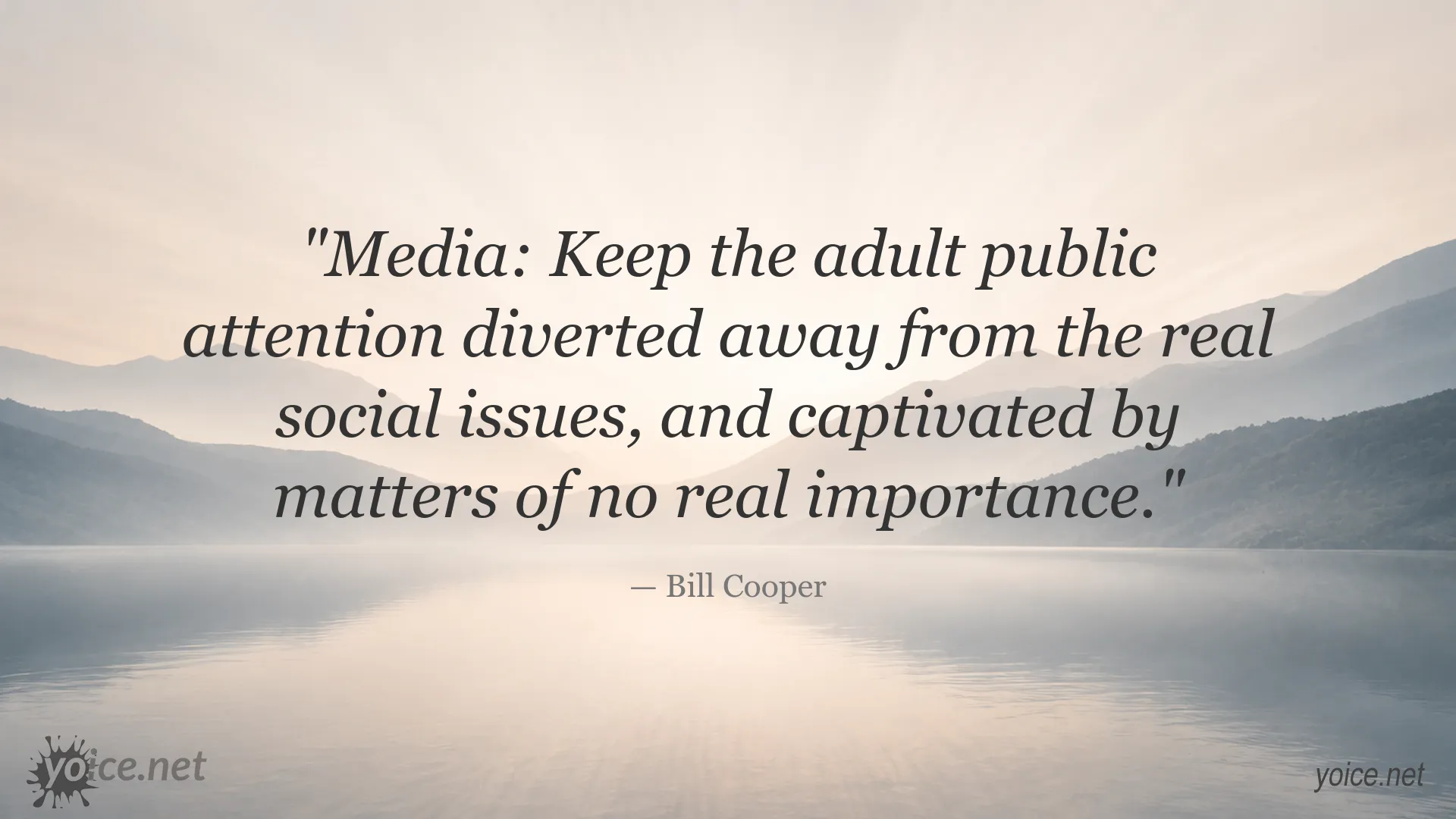
"Media: Keep the adult public attention diverted away from the real social issues, and captivated by matters of no real importance."
Bill Cooper
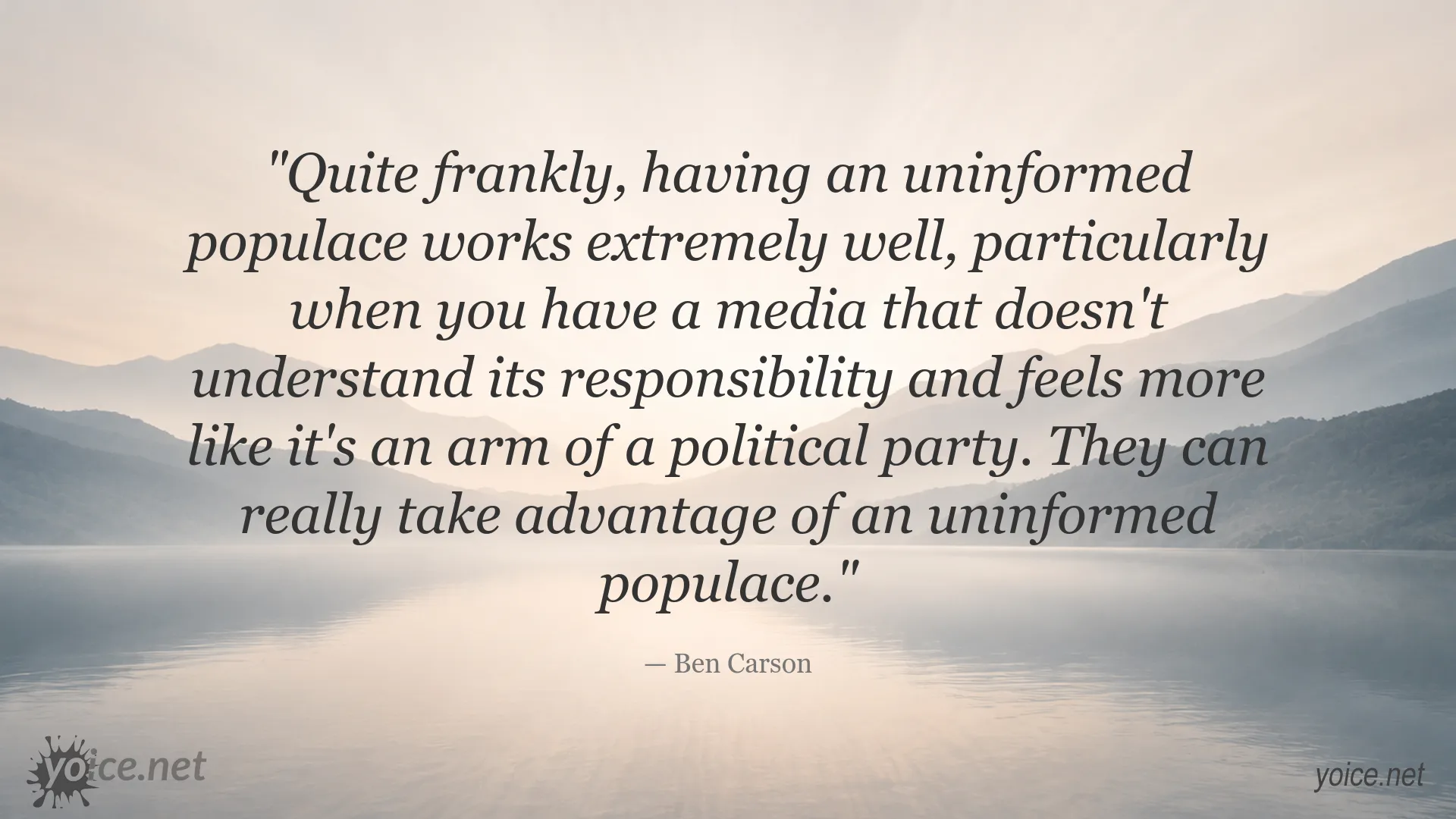
"Quite frankly, having an uninformed populace works extremely well, particularly when you have a media that doesn't understand its responsibility and feels more like it's an arm of a political party. They can really take advantage of an uninformed populace."
Ben Carson
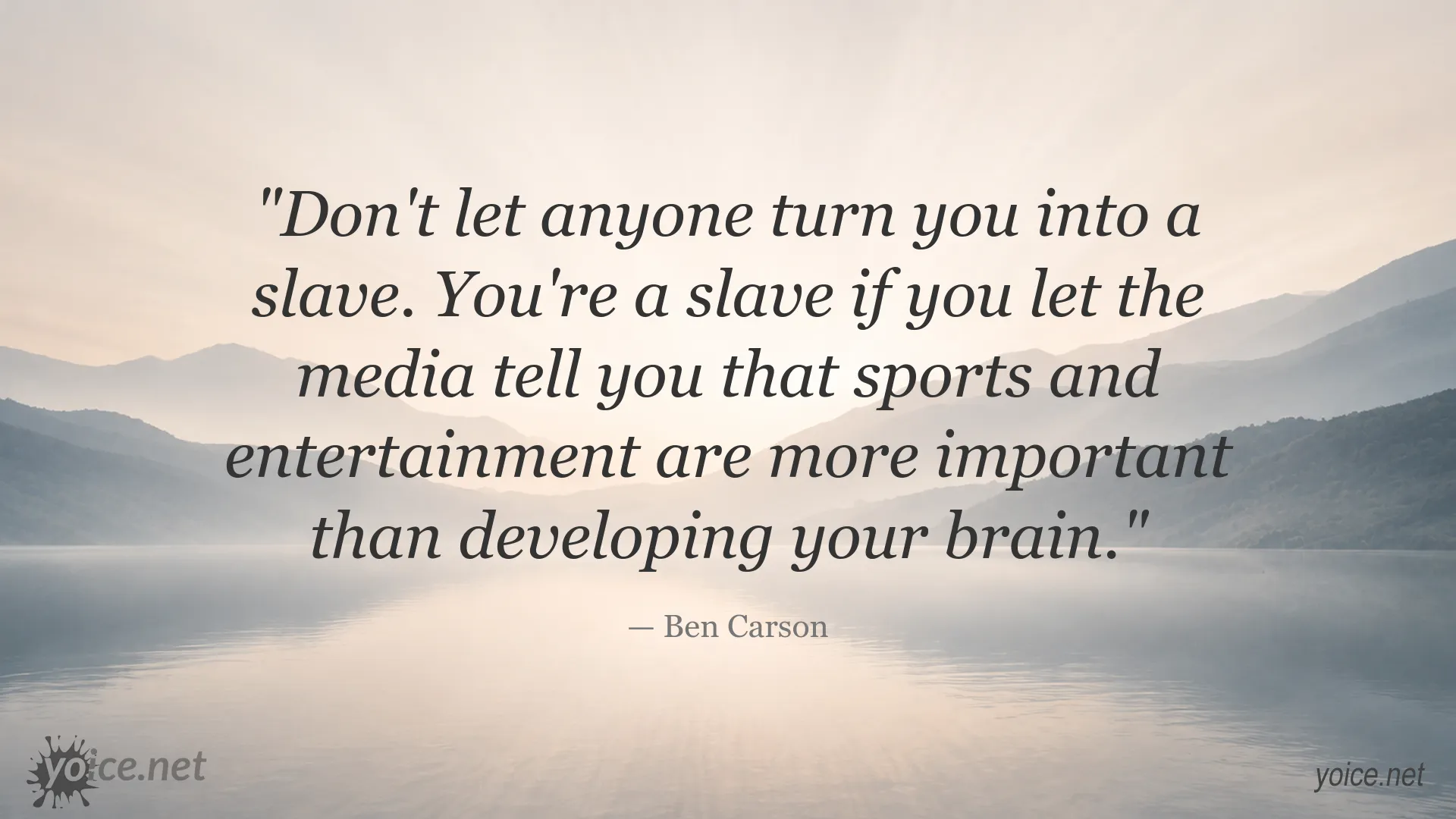
"Don't let anyone turn you into a slave. You're a slave if you let the media tell you that sports and entertainment are more important than developing your brain."
Ben Carson
"Our priests and presidents, our surgeons and lawyers, our educators and newscasters need worry less about satisfying the demands of their discipline than the demands of good showmanship."
Neil Postman
"The press needs to have the freedom to say all so that certain people don’t have the freedom to do all."
Stewart Alsop
"Journalists cannot serve two masters. To the extent that they take on the task of suppressing information or biting their tongue for the sake of some political agenda, they are betraying the trust of the public and corrupting their own profession."
Thomas Sowell
"The Pavlovian strategy in public relations has people conditioned more and more to ask themselves, "What do other people think?" As a result, a common delusion is created: people are incited to think what other people think, and thus public opinion may mushroom out into a mass prejudice. Expressed in psychoanalytic terms, through daily propagandistic noise backed up by forceful verbal cues, people can more and more be forced to identify with the powerful noisemaker. Big brother's voice resounds in all the little brothers."
Joost A.M. Meerloo
"Without some form of censorship, propaganda in the strict sense of the word is impossible. In order to conduct propaganda there must be some barrier between the public and the event"
Walter Lippmann
"The people in the public relations industry aren’t there for the fun of it. They’re doing work. They’re trying to instill the right values. In fact, they have a conception of what democracy ought to be: It ought to be a system in which the specialized class is trained to work in the service of the masters, the people who own the society. The rest of the population ought to be deprived of any form of organization, because organization just causes trouble. They ought to be sitting alone in front of the TV and having drilled into their heads the message, which says, the only value in life is to have more commodities or live like that rich middle class family you’re watching and to have nice values like harmony and Americanism. That’s all there is in life. You may think in your own head that there’s got to be something more in life than this, but since you’re watching the tube alone you assume, I must be crazy …"
Noam Chomsky
"The first bachelor generation is just climbing the university chairs. People who are perfectly trained in their craft, who have internalized the hegemonic ideology, and who are good advertising media for a system that needs academic confirmation in order to be able to continue to say 'democracy'. This generation already determines what 'good science' is. It fills journals, conference programs, and so eventually textbooks, lectures, and seminars - with topics, perspectives, and terms it has taken from the political agenda and the tenders linked to it, and which it doesn't question because it couldn't learn that anywhere."
Michael Meyen
"Interest groups make the policy. They pull the strings on which political puppets hang, who are allowed to pretend democracy on the stage of the Berlin puppet show. These political figures are then allowed to deflate their speech bubbles in the public service institutions with the toilet ladies Christiansen and Illner. And if there is still some dribbling left after their intellectual urination, they can mingle with the people at the emotional piss trough on Beckmann and Kerner."
Georg Schramm
"Friends, the press and the government have begun a relationship so intimate and immoral that it would make Satan himself blush with shame. Journalists used to question reasons for war and denounce abuses of power. Now they are like toothless babies, sucking on pacifiers of misinformation, only to poop it out into the diaper we call the 6 o'clock news."
Kent Brockman
"Not a day goes by without the mainstream media reporting on some war, epidemic, or other problem in the world. The problem is that this type of reporting, as we find it, is sheer madness. Information is distorted or not mentioned at all. It is the partial truths that make the press so dangerous. Wars are sold as “humanitarian interventions,” diseases are pushed to play into the hands of the pharmaceutical industry. There are always two sides to every coin, but we are only shown one side, which is supposed to be the “truth.” They show us what they want us to see and leave out what does not fit into their desired worldview. At this point, we should ask ourselves whether we want to continue consuming this filth and supporting it financially by buying certain tabloids such as Bild, Spiegel & Co. “Either you rebel, or you become complicit.”"
Ignazio Silone
"During lectures, I have repeatedly noticed that it is beneficial to clarify this obvious fact: No, the news is not a reflection of reality, not even a poor one. When we use mainstream media, we observe power relations in terms of definition. Who brings their topics and their view of things to the public? Who can I safely quote, who or what can or must I refer to? Which terms are appropriate and which are not? If the mainstream media say that there is a virus and a disease that I should be afraid of, then I have to take that seriously because those who decide about my life take it seriously. I can claim the opposite and attack the power of definition, but then I have to expect to lose all reputation (Wendler, Hildmann), being transferred (like Friedrich Pürner, head of the health department in the Aichach-Friedberg district until November 2020), or being kicked out of important committees (like Christoph Lütge from the Bavarian Ethics Council in February 2021) without any public resistance."
Prof. Dr. Michael Meyen
"The fact that Angela Merkel has been named the most powerful woman in the world is a farce. She is not even the most powerful woman in her own country. The fact that newspapers are now writing that Ursula von der Leyen is the second most powerful woman in Germany is a deliberate attempt by the press to dumb down the public. The two most powerful women in this country are Liz Mohn and Friede Springer – Bertelsmann and Bild Group. The Bild newspaper, which already carries the illiteracy of this country in its name. Bertelsmann and Bild are the vociferous heralds of a moribund system that is dangling from the strings of money lenders worldwide. A wave of Friede Springer's hand is enough, and the hired writers will finally dethrone the chancellor and throw her to her own party to be devoured. Perhaps we will see this happen soon. Those who are truly powerful are certain that they have already lost the favor of the people. That is what makes the chancellor so valuable. For as long as she has the favor of the people, she will be needed. But only as long as she has the favor of those in power will she be able to do so. In biology, this is called symbiosis. But when it is at the expense of the host animal, it is called parasitic symbiosis, and unfortunately, we are the host animal."
Georg Schramm alias Lothar Dombrowski
"Our task is not to tell the truth; we are opinion molders."
Walter Cronkite Jr.
"In former times, torture was used. Nowadays, the press is used. That is certainly progress."
Oscar Wilde
 Copyright © yoice.net – Quote Artwork
 Copyright © yoice.net – Quote Artwork
 Copyright © yoice.net – Quote Artwork
 Copyright © yoice.net – Quote Artwork
 Copyright © yoice.net – Quote Artwork
 Copyright © yoice.net – Quote Artwork
 Copyright © yoice.net – Quote Artwork
 Copyright © yoice.net – Quote Artwork
 Copyright © yoice.net – Quote Artwork
 Copyright © yoice.net – Quote Artwork
 Copyright © yoice.net – Quote Artwork
 Copyright © yoice.net – Quote Artwork
 Copyright © yoice.net – Quote Artwork
 Copyright © yoice.net – Quote Artwork
 Copyright © yoice.net – Quote Artwork
 Copyright © yoice.net – Quote Artwork
 Copyright © yoice.net – Quote Artwork