
„Today we cannot say that the Copernican theory is ‘right’ and the Ptolemaic theory ‘wrong’ in any meaningful physical sense.“
Fred HoyleSir Fred Hoyle explains why we cannot see theories as absolutely right or wrong – an inspiring perspective on science.
Sir Fred Hoyle was a British astronomer and mathematician who also wrote science fiction.
This quote invites reflection on the relativity of scientific theories and shows that truth often depends on perspective.
Translation or original: 🇩🇪Click here
Quelle: Hier klicken
i
3.0
/ 5
👥 Community:
Share this entry
Fred Hoyle (1915–2001) was a British astronomer known for his work in theoretical astrophysics, notably for his contributions to the theory of nucleosynthesis in stars. He was also a prolific science fiction writer and science communicator.
 Copyright © yoice.net – Quote Artwork
"The struggle, so violent in the early days of science, between the views of Ptolemy and Copernicus would then be quite meaningless. Either CS [coordinate system] could be used with equal justification. The two sentences, “the Sun is at rest and the Earth moves,” or “the Sun moves and the Earth is at rest,” would simply mean two different conventions concerning two different CS."
Albert Einstein
 Copyright © yoice.net – Quote Artwork
""The struggle, so violent in the early days of science, between the views of Ptolemy and Copernicus would then be quite meaningless. Either CS [coordinate system] could be used with equal justification. The two sentences, “the Sun is at rest and the Earth moves,” or “the Sun moves and the Earth is at rest,” would simply mean two different conventions concerning two different CS.""
Albert Einstein
 Copyright © yoice.net – Quote Artwork
"In this respect, it is interesting to contrast Einstein and Copernicus. Before Copernicus, people thought that the earth stood still and the heavens revolved about it once a day. Copernicus taught that “really” the earth rotates once a day, and the daily revolution of sun and stars is only “apparent.” Galileo and Newton endorsed this view, and many things were thought to prove it—for example, the flattening of the earth at the poles, and the fact that bodies are heavier there than at the equator. But in the modern theory the question between Copernicus and his predecessors is merely one of convenience; all motion is relative, and there is no difference between the two statements: “the earth rotates once a day” and “the heavens revolve about the earth once a day.” The two mean exactly the same thing, just as it means the same thing if I say that a certain length is six feet or two yards. Astronomy is easier if we take the sun as fixed than if we take the earth, just as accounts are easier in a decimal coinage. But to say more for Copernicus is to assume absolute motion, which is a fiction. All motion is relative, and it is a mere convention to take one body as at rest. All such conventions are equally legitimate, though not all are equally convenient."
Bertrand Russell
 Copyright © yoice.net – Quote Artwork
"For centuries the case of Galileo Galilei has been the cornerstone of every major argument against the church and its supposedly unscientific dogmatism. The church seems to have condemned Galileo for his heresies, just because it couldn’t and wouldn’t handle the truth. Galileo was a hero of science wrongfully accused and now – at last – everyone knows that. But is that true? This paper tries to examine the case from the point of modern physics and the conclusions drawn are startling. It seems that contemporary church was too haste into condemning itself. The evidence provided by Galileo to support the heliocentric system do not even pass simple scrutiny, while modern physics has ruled for a long time now against both heliocentric and geocentric models as depictions of the “truth”. As Einstein eloquently said, the debate about which system is chosen is void of any meaning from a physics’ point of view. At the end, the selection of the center is more a matter of choice rather than a matter of ‘truth’ of any kind. And this choice is driven by specific philosophical axioms penetrating astronomy for hundreds of years now. From Galileo to Hubble, the Copernican principle has been slowly transformed to a dogma followed by all mainstream astronomers. It is time to challenge our dogmatic adherence to the anti-humanism idea that we are insignificant in the cosmos and start making true honest science again, as Copernicus once postulated."
Spyridon Kakos
 Copyright © yoice.net – Quote Artwork
"If we consider that the advocates of the fixed and central position of the Earth can explain the heavenly phenomena as accurately, according to their own understanding, as we do, and that they additionally have the evidence of their senses, the Holy Scripture, and the facts on their side which we do not have, it is not without reason that they claim the superiority of their system. [...] However perfect our theoretical model may appear in our eyes, and however simple and satisfactory the Newtonian hypothesis may appear to us in explaining all celestial phenomena, here we must admit the astonishing truth that if our premises are challenged and our facts questioned, all of astronomy contains no proof of its own accuracy."
Dr. Robert Woodhouse
 Copyright © yoice.net – Quote Artwork
"Actually neither this Galileo, nor his mentor Copernicus, had a shred of truly tangible and unequivocal evidence for their heliocentric belief – and well do historians, astronomers, and philosophers of science know it! As I recently found it succinctly expressed in a research paper “Since Galileo science has shed logical proofs in favour of plausibility. Indeed, by this “scientific method” of adding plausible explanations to plausible explanations astronomy has arrived at the present view of the cosmos. However, those who forget that “plausible” and “proven” are not synonyms inevitably will see their chickens come home to roost.”"
Walter van der Kamp
 Copyright © yoice.net – Quote Artwork
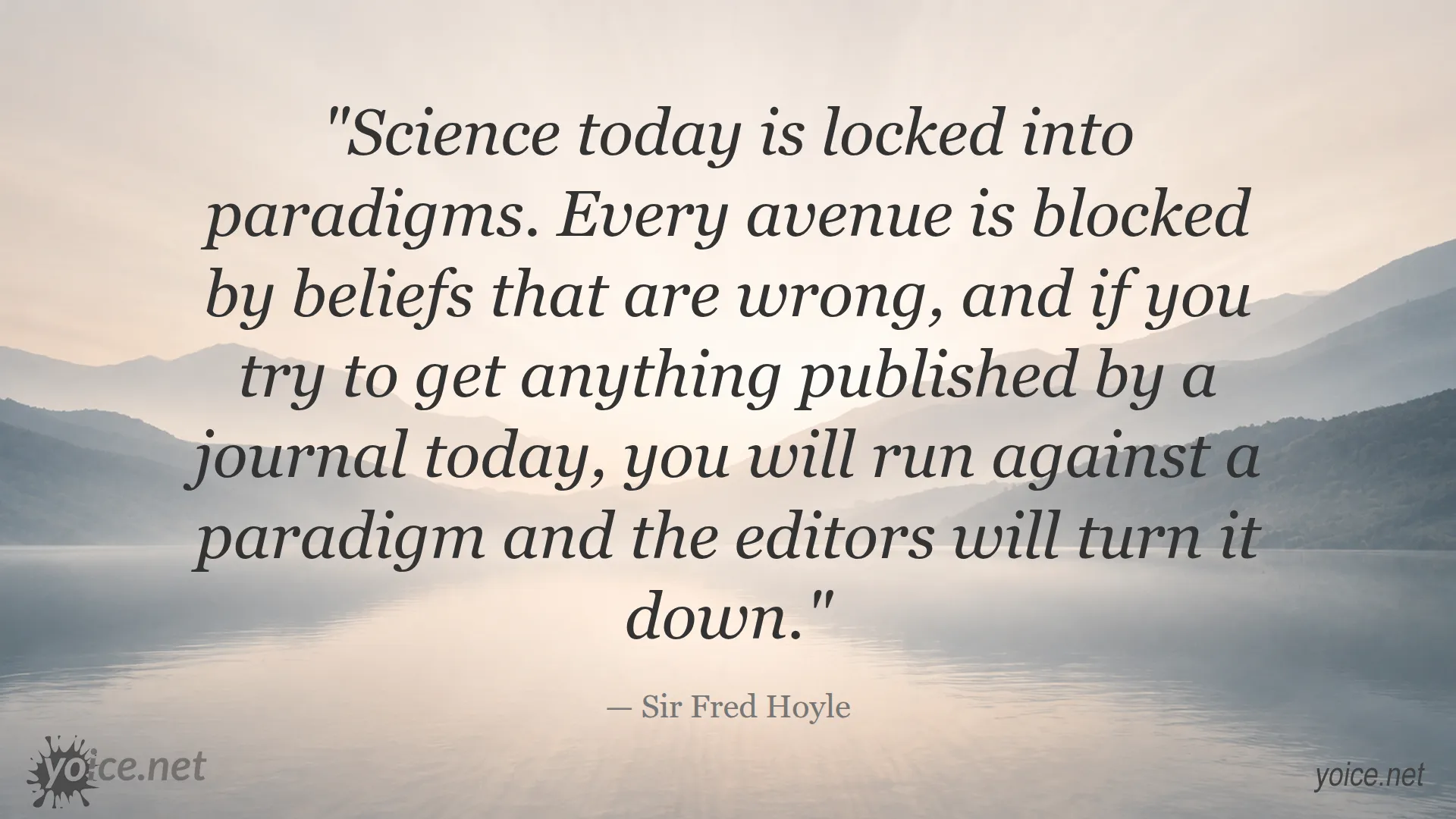 Copyright © yoice.net – Quote Artwork
Leave a Reply
Want to join the discussion?Feel free to contribute!