
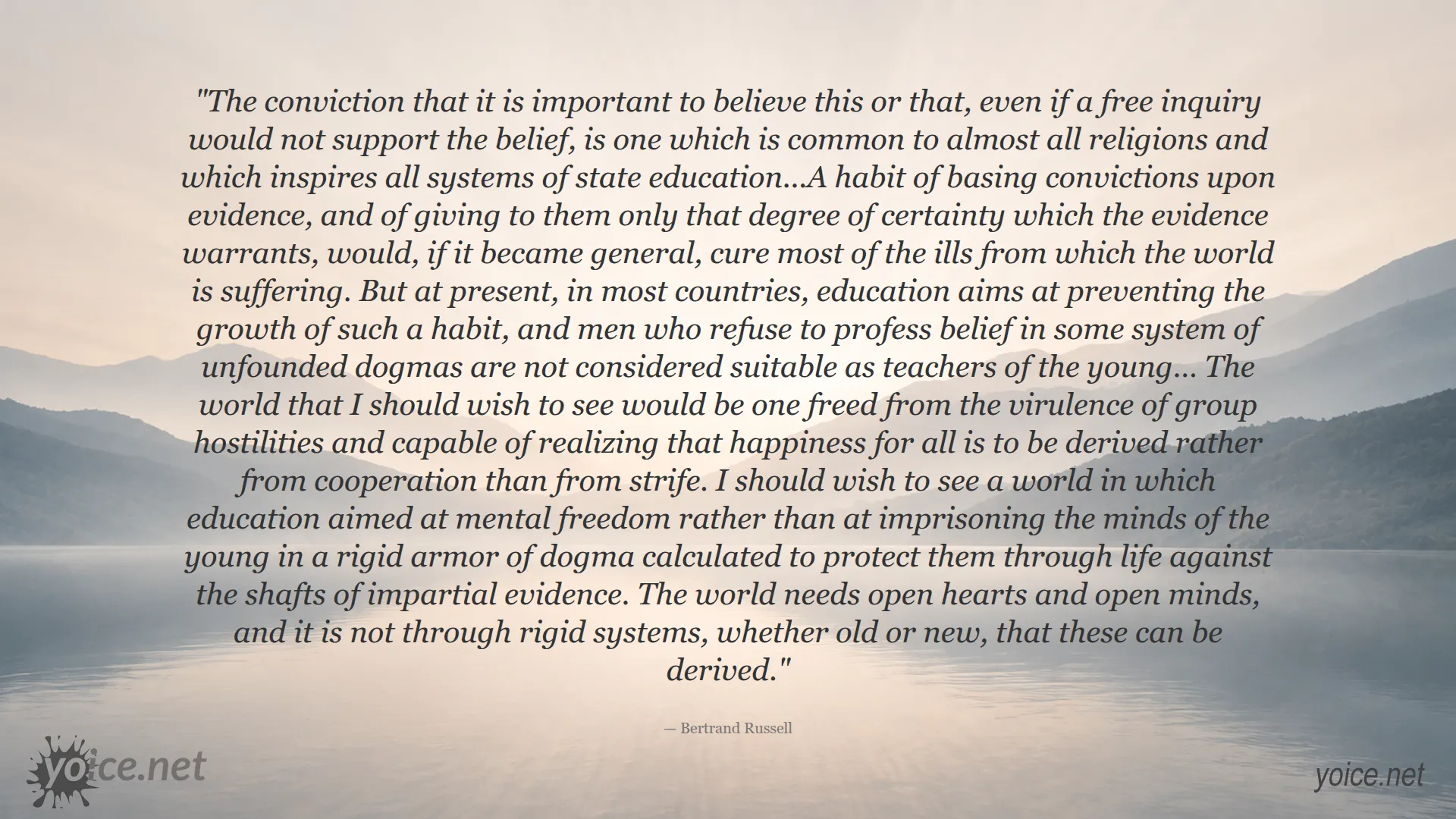
„The conviction that it is important to believe this or that, even if a free inquiry would not support the belief, is one which is common to almost all religions and which inspires all systems of state education...A habit of basing convictions upon evidence, and of giving to them only that degree of certainty which the evidence warrants, would, if it became general, cure most of the ills from which the world is suffering. But at present, in most countries, education aims at preventing the growth of such a habit, and men who refuse to profess belief in some system of unfounded dogmas are not considered suitable as teachers of the young…
The world that I should wish to see would be one freed from the virulence of group hostilities and capable of realizing that happiness for all is to be derived rather from cooperation than from strife. I should wish to see a world in which education aimed at mental freedom rather than at imprisoning the minds of the young in a rigid armor of dogma calculated to protect them through life against the shafts of impartial evidence. The world needs open hearts and open minds, and it is not through rigid systems, whether old or new, that these can be derived.“
Bertrand Russell was a British philosopher, mathematician, and social critic known for his work in logic and analytic philosophy.
Bertrand Russell urges us to question convictions critically and to see education as a path to mental freedom – a plea for openness and cooperation.
Translation or original: 🇩🇪Click here
Quelle: Hier klicken
i
Share this entry
Bertrand Arthur William Russell (1872–1970) was a prominent British philosopher, mathematician, and social critic. He made foundational contributions to logic, philosophy of mathematics, and analytic philosophy and was active in peace movements and critical political thought.
 Copyright © yoice.net – Quote Artwork
 Copyright © yoice.net – Quote Artwork
 Copyright © yoice.net – Quote Artwork
 Copyright © yoice.net – Quote Artwork
 Copyright © yoice.net – Quote Artwork
 Copyright © yoice.net – Quote Artwork
 Copyright © yoice.net – Quote Artwork
 Copyright © yoice.net – Quote Artwork
Leave a Reply
Want to join the discussion?Feel free to contribute!